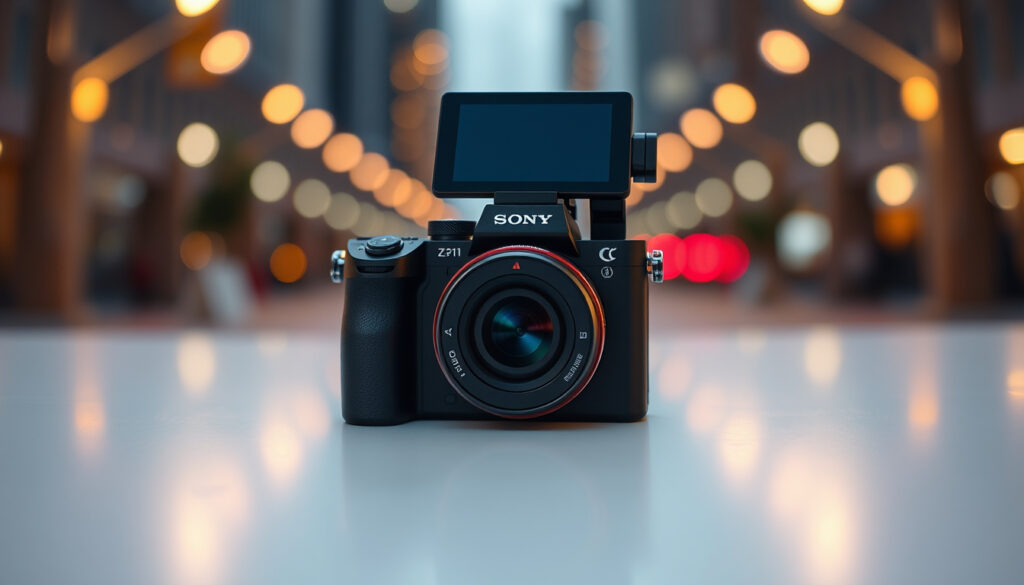
Sony ZV-E1 – Compact Full-Frame Vlog Camera Review
The Sony ZV-E1 represents a significant milestone in the evolution of vlogging cameras, combining full-frame image quality with AI-powered features in one of the most compact bodies Sony has ever produced. Since its release in 2023, this mirrorless camera has generated considerable discussion among content creators seeking professional-grade video capabilities without the bulk of traditional cinema equipment.
At its core, the ZV-E1 shares the same 12.1-megapixel back-illuminated CMOS sensor found in Sony’s acclaimed A7S III, a sensor specifically engineered for superior low-light performance and video capture. The camera’s dedicated AI processing chip, carried over from the A7R V, enables advanced subject recognition and tracking capabilities that set it apart from conventional hybrid cameras in its price range.
What is the Sony ZV-E1?
The Sony ZV-E1 is a compact full-frame mirrorless camera designed specifically for vloggers and content creators who demand professional-quality footage in a highly portable form factor. Unlike traditional hybrid cameras that attempt to balance photography and videography equally, the ZV-E1 prioritizes video creation while still offering capable still image functionality.
12MP Full-Frame BSI CMOS
4K up to 60p (120p upgrade)
AI Auto-Framing
Approximately $2,200
The camera introduces several vlogging-specific features not found in Sony’s other Alpha series models. Auto Framing automatically crops and centers on detected subjects, effectively giving solo creators the ability to appear in frame without a second camera operator. The flip-out vari-angle touchscreen, combined with one-touch controls for background defocus and product showcase modes, streamlines the vlogging workflow considerably.
- Full-frame sensor delivers superior depth of field control and low-light performance compared to APS-C or smaller sensors
- AI-powered subject recognition tracks humans, animals, birds, insects, and vehicles with phase-detection accuracy
- Compact 492g body makes it the lightest full-frame Alpha camera ever produced
- 10-bit 4:2:2 internal recording enables professional color grading workflows
- Built-in three-capsule microphone with wind noise reduction improves audio quality significantly
- Cinematic Vlog appearance presets offer one-tap creative looks without post-processing
- S-Log3 gamma curve provides over 15 stops of dynamic range for HDR content creation
| Specification | Detail |
|---|---|
| Sensor | 12.1MP full-frame BSI CMOS |
| Processor | BIONZ XR with dedicated AI chip |
| Lens Mount | Sony E-mount |
| ISO Range | 80-102,400 (expandable 40-409,600) |
| Dynamic Range | 15+ stops (S-Log3 at ISO 640) |
| Video Resolution | 4K/60p, Full HD/120p |
| Color Depth | 10-bit 4:2:2 internal |
| Continuous Shooting | 10fps electronic shutter |
| Screen | 3.0″ vari-angle touchscreen (1.03m dots) |
| Stabilization | In-body with Dynamic Active mode |
| Dimensions | 122.5 x 72.8 x 94.8mm |
| Weight | 492g (body only) |
What are the key Sony ZV-E1 specs?
Understanding the technical specifications reveals why the ZV-E1 has earned recognition as a specialized video tool rather than a general-purpose camera. The specifications reflect careful optimization for motion capture at the expense of certain still photography capabilities that casual users might expect from a full-frame camera.
Sensor and Processing Architecture
The 12.1-megapixel sensor represents a deliberate choice by Sony to prioritize pixel quality over pixel count. Each photosite captures more light information than higher-resolution alternatives, resulting in cleaner images at elevated ISO settings. The back-illumination structure moves wiring behind the light-sensitive area, increasing quantum efficiency particularly in challenging lighting conditions.
The BIONZ XR processor handles the heavy computational demands of 4K recording and AI operations simultaneously without introducing processing delays that would affect real-time monitoring. This processor architecture also enables the camera to maintain responsive autofocus performance even while recording high-bitrate 10-bit footage.
The AI dedicated chip, originally developed for the A7R V, processes subject recognition data independently from the main imaging pipeline. This separation ensures that complex tracking operations never compromise video quality or frame rate stability.
Video Capabilities and Recording Formats
The ZV-E1 records 4K footage at up to 60fps without pixel binning, meaning the full sensor resolution is utilized for maximum sharpness. Both All-I and LongGOP compression options are available, with All-I providing easier editing at the cost of larger file sizes. Full HD recording extends to 120fps for slow-motion applications, while the S&Q mode enables frame rates up to 240fps at reduced resolutions.
Professional color workflows benefit from S-Log3 gamma recording, which preserves highlight and shadow detail across more than 15 stops of dynamic range when shooting at the optimal ISO 640 base. The 10-bit 4:2:2 color sampling captures smooth gradations without the color banding artifacts common in 8-bit recordings during aggressive color grading.
Stabilization and Auto-Framing Technology
In-body image stabilization works alongside optical stabilization in compatible lenses to compensate for camera movement during handheld recording. The Dynamic Active mode applies digital correction alongside mechanical stabilization, providing approximately five times the correction ability of standard mode. However, this enhanced stabilization requires a slight crop of the recorded image area.
The AI Frame Stabilizer builds upon traditional stabilization by actively tracking the main subject and maintaining consistent framing even as the operator moves. Auto Framing goes further by automatically repositioning the crop window to keep detected subjects centered, effectively simulating a second operator managing camera movements.
Lens Compatibility
The Sony E-mount accepts the full range of Sony E-mount lenses, including both full-frame and APS-C format options. For vlogging applications, wide-angle lenses in the 16-35mm range provide comfortable framing with sufficient background context, while prime lenses such as the 20mm f/1.8 G offer superior low-light performance and creamy bokeh effects at accessible price points.
The full-frame sensor enables shallower depth of field at equivalent apertures compared to smaller sensors, making it easier to separate subjects from backgrounds even with relatively modest lenses. This characteristic proves particularly valuable for interview-style vlogs where subject isolation improves visual focus.
Is the Sony ZV-E1 good for vlogging?
The camera delivers exceptional performance for solo content creators prioritizing video quality over photography versatility. The combination of full-frame image quality, AI-powered features, and compact dimensions creates a vlogging tool that addresses many limitations of previous generation cameras in this category.
Autofocus Performance for Self-Recording
The phase-detection autofocus system covers the majority of the sensor area, enabling accurate focus across a wide range of subject positions without requiring constant recomposition. AI subject recognition identifies humans, animals, birds, insects, and vehicles, maintaining focus even when subjects turn partially away from the camera or become momentarily obscured.
Real-world testing demonstrates that the autofocus maintains reliable tracking during walking sequences and varied lighting conditions commonly encountered during outdoor vlogging sessions. The system’s ability to predict subject movement helps avoid the focus hunting problems that plagued earlier mirrorless cameras during video recording.
Image Quality and Low-Light Performance
The sensor architecture excels in low-light environments where smaller sensors produce excessive noise. Images maintain usable detail and accurate colors at ISO settings well beyond what smartphone cameras or APS-C mirrorless options can achieve, making the ZV-E1 practical for evening walks, indoor locations, and other dimly lit scenarios.
The 15+ stop dynamic range in S-Log3 mode provides ample latitude for recovering highlight detail in high-contrast scenes, though achieving this performance requires careful attention to exposure technique and color grading in post-production. Standard recording modes provide more immediately usable footage with less post-processing overhead.
Overheating limitations affect extended recording sessions, particularly when capturing 4K footage at elevated frame rates. Sony specifies approximately 60 minutes of continuous 4K/60p recording before thermal warnings appear, though actual performance varies significantly based on ambient temperature and camera settings. Unlike the A7S III, the ZV-E1 lacks active cooling provisions, making extended takes in warm environments challenging without additional mitigation strategies.
Audio and Connectivity Features
The redesigned internal microphone array uses three capsules to capture directional audio while reducing wind noise and background distractions. This microphone system produces noticeably better audio quality than external microphones attached to traditional hot shoe implementations, particularly in controlled indoor environments.
Live streaming capability through USB-C allows the camera to function as a high-quality webcam or broadcast device, supporting 4K/30p or Full HD/60p streaming without requiring separate capture hardware. Wi-Fi and Bluetooth connectivity enable wireless image transfer and remote control through the Sony Creators’ Cloud platform.
How much does the Sony ZV-E1 cost and is it worth it?
The ZV-E1 occupies a mid-range price position, retailing approximately $2,200 for the body only. This pricing reflects its position as a specialized video tool rather than a general-purpose hybrid camera, placing it below the professional-grade A7S III while exceeding consumer-oriented options like the ZV-1 or A7C.
The camera offers compelling value for creators who primarily produce video content, delivering image quality equivalent to the significantly more expensive A7S III in a smaller, more affordable package. The AI features and vlogging-specific optimizations justify the price premium over the A7C for video-focused users, despite the A7C offering better still photography resolution and battery life.
Considerations for different user profiles suggest that the ZV-E1 excels for dedicated vloggers and YouTubers who prioritize video quality and feature convenience over photography capabilities. However, users requiring electronic viewfinders, mechanical shutters, or extended continuous recording without thermal concerns should evaluate the A7S III or alternative options more carefully. For those prioritizing video quality and convenience, the ZV-E1 is an excellent choice, and you can read our Poco X7 Pro review for more details.
The investment proves particularly worthwhile for creators building content libraries that benefit from the full-frame aesthetic and professional color grading capabilities. The 10-bit recording and S-Log3 workflow enable consistent visual quality across multiple projects while providing flexibility for future format requirements.
As with any specialized tool, the total cost of ownership extends beyond the initial purchase to include memory cards, batteries, cases, and potentially lenses if transitioning from incompatible systems. Planning for these additional expenses helps ensure the overall investment aligns with budget expectations and creative requirements.
Sony ZV-E1 vs ZV-1: Key differences
The comparison between the ZV-E1 and its predecessor reveals fundamental differences in sensor technology, processing capability, and target audience. While both cameras share the ZV branding and vlogging-focused features, their underlying technologies reflect different priorities and use cases.
| Feature | ZV-E1 | ZV-1 |
|---|---|---|
| Sensor Size | Full-frame (36 x 24mm) | 1-inch (13.2 x 8.8mm) |
| Resolution | 12.1 megapixels | 20.1 megapixels |
| 4K Maximum | 60fps (120fps with upgrade) | 30fps |
| Color Depth | 10-bit 4:2:2 | 8-bit 4:2:0 |
| Lens Mount | Sony E-mount (interchangeable) | Fixed 24-70mm equivalent |
| AI Features | Full AI suite with Auto Framing | Basic subject tracking |
| Dynamic Range | 15+ stops (S-Log3) | Approximately 12 stops |
| Price | $2,200 | $750 |
The sensor size difference fundamentally impacts image quality characteristics. Full-frame sensors capture significantly more light per pixel, producing superior results in dim conditions and enabling more pronounced background blur at equivalent aperture settings. This advantage becomes particularly noticeable in portrait-style vlogs where shallow depth of field separates subjects from distracting backgrounds.
The interchangeable lens system of the ZV-E1 provides creative flexibility unavailable with the ZV-1’s fixed zoom lens. Users can select wide-angle primes for walk-around vlogging, fast standard zooms for versatility, or specialized glass for specific creative effects. This adaptability makes the ZV-E1 suitable for evolving creative needs over time.
The ZV-1 remains a capable option for beginners and casual creators who prioritize portability and simplicity over maximum image quality. Its fixed lens eliminates the learning curve associated with lens selection while maintaining respectable video quality in favorable lighting conditions.
Understanding overheating limitations
Thermal management represents one of the most significant engineering trade-offs in the ZV-E1’s design. The compact body that enables exceptional portability simultaneously limits the camera’s ability to dissipate heat generated during extended high-resolution recording. Understanding these limitations helps users plan shoots and implement mitigation strategies effectively.
Sony specifies approximately 60 minutes of continuous 4K/60p recording before thermal warnings appear. Performance degrades significantly in ambient temperatures above 25°C (77°F), with some users reporting shutdowns within 30 minutes during summer outdoor use. The camera lacks the active cooling system included in the A7S III, making extended takes challenging without external solutions or workflow adjustments.
Practical workarounds include breaking longer recordings into segments to allow cooling periods, using the camera in shade or air-conditioned environments, reducing frame rates or resolution when extended duration takes are required, and positioning the camera to maximize airflow around the body during operation.
Battery life compounds the thermal challenge, as the NP-FZ100 battery typically depletes before thermal limits affect recording in burst scenarios. Carrying multiple batteries and planning power management strategies ensures uninterrupted recording during important shoots.
Confirmed information and areas of uncertainty
Reviewers and users have established certain facts through testing and practical experience, while other aspects remain less clearly documented or subject to variation based on specific conditions and configurations.
Verified information
- 12.1MP full-frame BSI CMOS sensor shared with A7S III
- BIONZ XR processor with dedicated AI chip
- 4K/60p recording without pixel binning
- 10-bit 4:2:2 internal recording capability
- AI subject recognition for humans, animals, birds, insects, vehicles
- Auto Framing with AI-based subject tracking
- 492g body weight with full-frame sensor
- S-Log3 gamma providing 15+ stops dynamic range
- Sony E-mount lens compatibility
- Vari-angle touchscreen implementation
- Built-in three-capsule directional microphone
Areas requiring verification
- Actual continuous recording duration varies by temperature and settings
- 4K/120p availability depends on regional firmware and paid upgrade status
- Long-term reliability and component wear patterns undocumented
- Real-world battery performance varies significantly based on usage patterns
- Specific lens compatibility testing incomplete for third-party options
The ZV-E1 in Sony’s camera ecosystem
The ZV-E1 occupies a unique position within Sony’s Alpha series, representing the company’s most focused implementation of video-optimized features in a consumer accessible form factor. The camera bridges the gap between smartphone-based content creation and professional cinema camera production, enabling creators to achieve visually sophisticated results without extensive technical knowledge.
Sony’s strategic focus on the vlogging market reflects broader industry trends toward video-first content creation platforms. The ZV-E1 demonstrates how specialized hardware can address specific creative workflows more effectively than general-purpose alternatives, even when those general-purpose options offer broader feature sets.
The camera’s compact dimensions challenge assumptions about the relationship between sensor size and body volume, proving that full-frame image quality can be achieved in genuinely portable configurations. This achievement influences future product development across the industry as competitors respond to consumer demand for professional features in travel-friendly formats.
Perspectives from professional reviewers
Industry assessments consistently highlight the ZV-E1’s exceptional video capabilities while noting specific limitations that affect certain use cases. Reviewers have praised the camera’s autofocus performance as unrivaled among vlogging-focused options, with particular emphasis on the AI subject recognition capabilities that simplify complex shooting scenarios.
“The Sony ZV-E1 earns its reputation as a pint-sized vlogging powerhouse, delivering full-frame quality in a form factor that fundamentally changes what’s possible for solo content creators.”
Image quality assessments document excellent 4K footage with minimal noise through ISO 6400, enabling confident use in lighting conditions that challenge smaller sensors. The dynamic range in S-Log3 mode provides adequate latitude for highlight recovery in high-contrast scenes, though achieving optimal results requires familiarity with Sony’s color science and exposure techniques.
Critics point to the lack of electronic viewfinder and heat management limitations as significant omissions for certain professional applications. The fixed crop required for Dynamic Active stabilization and the absence of a mechanical shutter also affect usability in specific scenarios, though these limitations reflect deliberate design decisions optimizing the camera for its primary video use case.
“For vloggers seeking the ultimate compact full-frame video camera, the ZV-E1 delivers features and image quality that reignite enthusiasm for content creation while accepting manageable trade-offs in exchange for unprecedented portability.”
Final assessment
The Sony ZV-E1 succeeds in delivering professional-grade video capabilities in an exceptionally compact full-frame package. The camera excels for solo content creators who prioritize image quality, intelligent autofocus, and streamlined vlogging features over still photography versatility or extended recording duration.
The investment makes sense for dedicated video creators building libraries of high-quality content, particularly those who already own Sony E-mount lenses or are willing to invest in the system. The AI features and professional color workflow capabilities provide genuine value that justifies the price premium over consumer-oriented alternatives.
Users should plan for the thermal limitations and battery management requirements that affect extended shooting scenarios, adjusting workflows accordingly to maximize the camera’s considerable strengths. For those who require longer continuous recording, electronic viewfinders, or comprehensive weather sealing, the A7S III or other specialized options remain more appropriate choices despite their higher cost and larger dimensions.
The ZV-E1 represents a significant achievement in camera design, demonstrating that specialized video tools can deliver results previously requiring substantially more expensive and complex equipment. For creative professionals committed to the vlogging format, this camera provides capabilities that genuinely enhance creative possibilities while maintaining practical portability for travel and outdoor shooting.
Frequently asked questions
Does the Sony ZV-E1 have in-body image stabilization?
Yes, the camera includes five-axis in-body image stabilization that works with compatible lenses. The Dynamic Active mode applies additional digital correction for approximately five times the stabilization capability of standard mode, though this enhancement requires a slight crop of the recorded image.
Can the Sony ZV-E1 shoot 10-bit video?
Yes, the camera records 10-bit 4:2:2 video internally using All-I or LongGOP compression. This color depth enables smooth gradations and supports aggressive color grading without introducing banding artifacts in the footage.
Is the Sony ZV-E1 weather-sealed?
Sony has not officially specified weather sealing for the ZV-E1. The camera should be protected from rain and dust exposure similar to other non-weather-sealed Alpha series models to prevent damage to internal components.
What memory cards does the ZV-E1 support?
The camera uses a single SD card slot that supports UHS-II speed ratings for optimal performance with high-bitrate video recording. Users should select cards with sufficient write speeds to handle continuous 4K recording without dropped frames.
Can the ZV-E1 be used as a webcam?
Yes, the camera supports USB-C streaming at up to 4K/30p or Full HD/60p resolution. The UVC standard compatibility enables plug-and-play operation with computers and streaming platforms without additional capture hardware.
Does the camera have a microphone input?
The ZV-E1 includes a 3.5mm microphone jack for external audio sources in addition to its built-in three-capsule directional microphone system. This input enables use of professional microphones and wireless audio receivers for enhanced sound quality.
What is the battery life of the ZV-E1?
Battery life varies significantly based on recording settings, screen usage, and environmental conditions. The NP-FZ100 battery provides limited duration in burst recording scenarios, with practical use typically requiring multiple batteries for full-day shooting schedules.
Is the ZV-E1 compatible with APS-C lenses?
Yes, the camera accepts both full-frame and APS-C format Sony E-mount lenses. APS-C lenses produce a cropped image matching their smaller coverage area, which can be advantageous for telephoto applications where the additional reach extends effective focal length.
More related posts
 Exercises for Lower Back Pain: NHS Guide
 Bob Monkhouse: Career, Family, Catchphrases, and Death
 American Golf Near Me – Find UK Stores, Hours & Deals
 Travis Fimmel: Life After Vikings and Dune: Prophecy Role
 How Old Was Elvis When He Met Priscilla? Ages & Timeline
 Spencer Matthews: Net Worth, Family, Royal Connection & Children
 West Indies Cricket Team: Players, Rankings & Schedule
 7 Letter Word Finder: Un cramble & Win at Scrabble