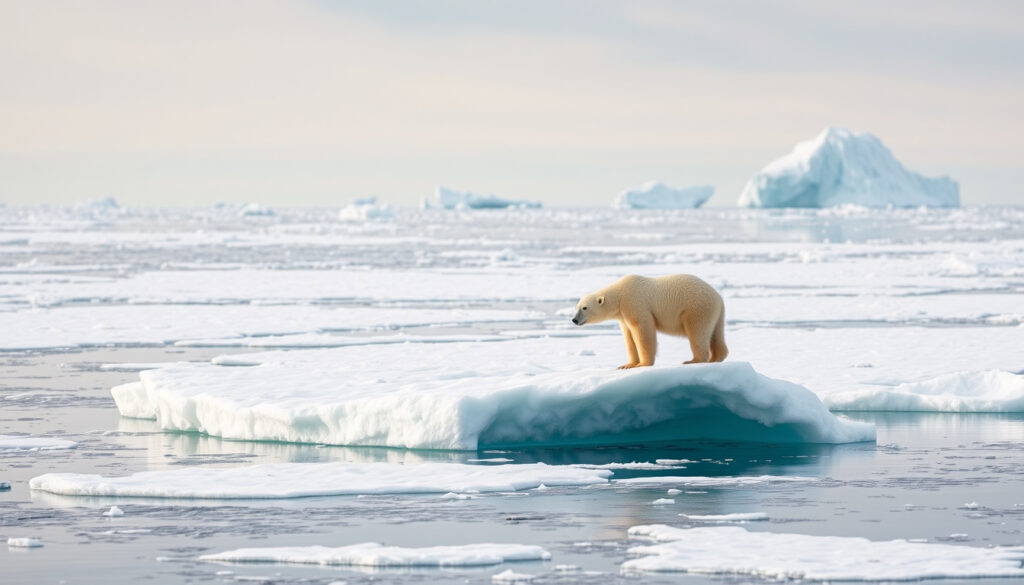
Polar Bears: Facts on Habitat, Population & Threats
There’s something magnetic about a polar bear—the way it moves across the ice, a speck of cream on an endless white field. But behind that majesty lies a story of survival that gets more urgent every year, pulling together the latest facts, population estimates, and conservation challenges to give you the full picture of where polar bears stand right now.
Largest land carnivore: Adult males 300–800 kg · Current population: 22,000–31,000 · IUCN status: Vulnerable · Primary habitat: Arctic sea ice · Swimming endurance: Up to 100 km nonstop
Quick snapshot
- Largest land carnivore and marine mammal (WWF UK (wildlife conservation body))
- Found only in the Arctic, in 5 nations (WWF (global conservation organization))
- IUCN Red List status: Vulnerable (IUCN Red List (global authority on species status))
- Primary diet: ringed and bearded seals (The Marine Mammal Center (marine mammal research & rescue))
- Exact number of polar bears in 2050 (IUCN Red List (global authority on species status))
- Whether all 20 subpopulations will decline uniformly (WWF UK (wildlife charity))
- Effectiveness of some regional conservation measures (Polar Bears International (polar bear research & advocacy))
- 1973: Arctic nations sign the Agreement on Conservation of Polar Bears (Polar Bears International (polar bear research & advocacy))
- 2008: U.S. lists polar bear as threatened under Endangered Species Act (U.S. Fish & Wildlife Service (federal wildlife agency))
- 2023: 5-year review reaffirms threatened status (U.S. Fish & Wildlife Service (federal wildlife agency))
- Some subpopulations may disappear by 2050 under current warming trends (IUCN Red List (global authority on species status))
- Continued monitoring of sea ice loss and prey availability (Marine Mammal Commission (U.S. federal advisory body))
- International cooperation remains key to conservation (Polar Bears International (polar bear research & advocacy))
For a quick reference, here are the polar bear’s vital statistics.
| Attribute | Value |
|---|---|
| Scientific Name | Ursus maritimus |
| Weight (males) | 300–800 kg |
| Length | 2.4–3.0 m |
| Conservation Status | Vulnerable (IUCN Red List) |
| Population Estimate | 22,000–31,000 (IUCN Red List) |
| Top Speed (land) | 40 km/h |
| Lifespan (wild) | 25–30 years |
What are 5 facts about polar bears?
Polar bears are built for extremes. Here are the five most important facts that define them.
How big are polar bears?
- Adult males weigh between 300 and 800 kg, with some individuals reaching 1,000 kg. Females are roughly half that size, typically 150–290 kg (WWF UK (wildlife conservation body)).
- Standing up to 3 meters tall on hind legs, they are the largest land carnivore on Earth (The Marine Mammal Center (marine mammal research & rescue)).
What do polar bears eat?
- Their diet is almost exclusively seals, especially ringed and bearded seals (The Marine Mammal Center (marine mammal research & rescue)).
- They are opportunistic scavengers and will also eat carcasses, birds, and vegetation when seals are scarce (WWF (global conservation organization)).
How long do polar bears live?
- In the wild, polar bears typically live 25–30 years, though a well-fed individual can reach 35. In captivity, lifespans are slightly longer (The Marine Mammal Center (marine mammal research & rescue)).
The implication: these five facts paint a picture of a species exquisitely adapted to a vanishing world.
How many polar bears will be left in 2050?
Are polar bears endangered?
- Currently classified as Vulnerable on the IUCN Red List and threatened under the U.S. Endangered Species Act (IUCN Red List (global authority on species status); U.S. Fish & Wildlife Service (federal wildlife agency)).
- Climate-driven sea-ice loss is the principal threat driving the species toward endangerment (IUCN Red List (global authority on species status)).
How many polar bears are there currently?
- The global population is estimated between 22,000 and 31,000 individuals, with the best estimate around 26,000 (IUCN Red List (global authority on species status)).
- Some sources give a tighter range of 20,000–25,000 (The Marine Mammal Center (marine mammal research & rescue)).
Projections for 2050 are sobering. According to the IUCN, if sea-ice loss continues at current rates, some subpopulations could disappear entirely by mid-century (IUCN Red List). The implication: the polar bear’s survival is now a race against the Marine Mammal Commission (U.S. federal advisory body)’s warning that sea-ice decline and prey loss are the species’ primary threat.
What is the polar bear’s only predator?
What is the biggest killer of polar bears?
- The polar bear has no natural predators in the wild. Adult bears are apex predators. However, human activity is the primary cause of mortality—through hunting, pollution, and habitat destruction (IUCN Red List (global authority on species status)).
- Climate change is described as the single biggest threat, as it melts the sea ice polar bears depend on for hunting and breeding (Polar Bears International (polar bear research & advocacy)).
- Orcas have been known to prey on polar bears at very rare occasions, but this is not a significant factor (National Geographic (science and exploration media)).
An apex predator with no natural enemy is being pushed to the edge by an invisible foe: a warming planet. For Arctic coastal communities, the loss of polar bears signals the unraveling of an entire ecosystem.
The implication: the polar bear’s greatest enemy is not a tooth or claw, but a changing climate.
Are polar bears Arctic or antarctic?
Where do polar bears live?
- Polar bears are found exclusively in the Arctic, not Antarctica (WWF UK (wildlife charity)).
- Their range spans five countries: Canada, the United States (Alaska), Russia, Norway (Svalbard), and Greenland (Denmark) (WWF (global conservation organization)).
- Within this range, there are 20 recognized subpopulations (WWF UK (wildlife conservation body)).
What is the polar bear’s habitat like?
- Polar bears live on sea ice—the frozen ocean surface—which they use as a platform for hunting seals, traveling, resting, and denning (WWF (global conservation organization)).
- They are classified as marine mammals because their survival is tied directly to the marine environment (The Marine Mammal Center (marine mammal research & rescue)).
Six polar bear facts, one pattern: their distribution mirrors the seasonal extent of sea ice. Where the ice is, the bears are. The catch: as Arctic sea ice shrinks, so does their range.
Are polar bears aggressive?
Are polar bears dangerous to humans?
- Polar bears are apex predators and can be dangerous, especially when hungry or provoked. However, attacks on humans are extremely rare (National Geographic (science and exploration media)).
- They generally avoid humans, but bears that are food-stressed may approach settlements (WWF (global conservation organization)).
How do polar bears behave?
- Polar bears are solitary animals, except during mating or when a mother is raising cubs (Polar Bears International (polar bear research & advocacy)).
- They are curious and intelligent, but not naturally aggressive toward humans unless they feel threatened or are starving (The Marine Mammal Center (marine mammal research & rescue)).
As sea ice declines, polar bears spend more time on land, increasing encounters with humans. For Arctic towns, this means adapting safety protocols and coexistence strategies—or facing more conflicts.
The takeaway: understanding polar bear behavior is key to coexistence in a warming Arctic.
Polar bear vs brown bear: a comparison
Three bear species, one critical distinction: polar bears are built for ice, brown bears for land. Here’s how they stack up.
| Trait | Polar Bear (Ursus maritimus) | Brown Bear / Grizzly (Ursus arctos) |
|---|---|---|
| Weight (males) | 300–800 kg | 180–360 kg |
| Length | 2.4–3.0 m | 1.8–2.1 m |
| Primary habitat | Arctic sea ice | Forests, mountains, tundra |
| Diet | Primarily seals | Omnivorous (fish, berries, mammals) |
| Top speed (land) | 40 km/h | 48 km/h |
| Conservation status | Vulnerable (IUCN) | Least Concern (IUCN) |
| Hibernation | Only pregnant females den | All adults hibernate |
The pattern is clear: polar bears are larger but more specialized, making them far more vulnerable to habitat change than their adaptable cousins.
Timeline: key milestones in polar bear conservation
- 1973 – The five Arctic nations sign the Agreement on Conservation of Polar Bears, the first international treaty focused on the species (Polar Bears International (polar bear research & advocacy)).
- 2006 – IUCN reclassifies the polar bear from Least Concern to Vulnerable (IUCN Red List (global authority on species status)).
- 2008 – U.S. Fish & Wildlife Service lists the polar bear as threatened under the Endangered Species Act due to projected sea-ice loss (U.S. Fish & Wildlife Service (federal wildlife agency)).
- 2020 – Accelerated sea-ice loss recorded in the Barents Sea and other regions; some subpopulations show declines (Marine Mammal Commission (U.S. federal advisory body)).
- 2023 – 5-year status review completed by USFWS; threatened classification upheld (U.S. Fish & Wildlife Service (federal wildlife agency)).
- 2050 – Projected disappearance of some subpopulations if current warming trends continue (IUCN Red List (global authority on species status)).
What this means: the timeline is not just history—it’s a countdown. Every data point since 1973 shows the same direction: ice loss accelerating, bears under pressure.
What we know and what’s uncertain
Confirmed facts
- They are found only in the Arctic (The Marine Mammal Center (marine mammal research & rescue)).
- They depend on sea ice for hunting (WWF UK (wildlife conservation body)).
- Climate change is the primary threat (WWF (global conservation organization)).
What’s unclear
- Exact number of polar bears in 2050 (IUCN Red List (global authority on species status)).
- Whether all subpopulations will decline uniformly (WWF UK (wildlife conservation body)).
- Effectiveness of some conservation measures (Polar Bears International (polar bear research & advocacy)).
- Whether polar bears are definitively the largest land carnivores, as some sources qualify the term (WWF UK (wildlife conservation body)).
The pattern: what we know far outweighs what we don’t, and the known facts point to a species in peril.
Voices from the field
“Polar bears are the sentinel species of the Arctic—their health tells us how the entire ecosystem is faring.”
— WWF (global conservation organization)
“The most important polar bear habitats are the edges of the pack ice, where the ocean meets the ice and seals are most abundant.”
— Defenders of Wildlife (U.S. wildlife conservation nonprofit)
“Polar bears are incredibly strong swimmers, covering distances of up to 100 kilometers in a single swim when necessary.”
— National Geographic (science and exploration media)
These expert perspectives reinforce the urgency of the polar bear’s plight.
What this means for the future
Polar bears are not just symbols of the Arctic—they are indicators of a planet in transition. For conservationists and policymakers in Arctic nations, the trade-off is clear: preserve sea ice habitat, or watch subpopulations vanish by 2050. The choice is no longer theoretical; it’s being written in the melting ice.
pmc.ncbi.nlm.nih.gov, en.wikipedia.org, interactive.carbonbrief.org
For a closer look at their shrinking habitat, an in-depth guide on polar bears offers expert-backed facts on population and conservation status.
Frequently asked questions
Do polar bears hibernate?
Only pregnant females enter a denning period over winter. Other polar bears remain active year-round, though they may reduce activity during the coldest months.
Can polar bears live in Antarctica?
No. Polar bears evolved in the Arctic and are not found in Antarctica. Introducing them would disrupt the Antarctic ecosystem.
What is the scientific name for a polar bear?
Ursus maritimus, which means “maritime bear.”
How do polar bears stay warm?
They have a thick layer of blubber (up to 11 cm) and a dense double-layer coat that insulates against extreme cold.
What is the IUCN status of polar bears?
Vulnerable (assessed 2006, reaffirmed in subsequent reviews) (IUCN Red List).
How fast can a polar bear swim?
They can swim at about 10 km/h, but can cover long distances of up to 100 km nonstop.
Are polar bears social animals?
No, they are usually solitary. The only lasting bonds are between mother and cubs.
More related posts
 Houses for Sale Bangor – Current Listings, Prices and Trends
 DPF Cleaning Near Me: Costs & Best Services in Ireland
 HD Lobos Natura Fuerteventura: Hotel Guide & Isla de Lobos Tips
 Coffee Machine with Milk Frother: Best Picks for Ireland Homes
 How Many Seconds in a Day? 86,400 and Smart Investing
 Part-Time Jobs Near Me in Ireland: Pay, Tips, and Opportunities
 Demon Slayer Season 5 Release Date – Infinity Castle Trilogy in 2025
 Penny Spencer: Life After Please Sir, Age & Net Worth