Difference Between Crocodile and Alligator: 6 Key Facts
Most people spot a big scaly reptile and reach for the nearest exit—but telling a crocodile from an alligator is easier than you think. The difference comes down to a few physical tricks anyone can learn in under a minute.
Snout Shape: Alligator U-shaped, Crocodile V-shaped · Color: Alligators dark grey, Crocodiles greenish brown · Teeth Visibility: Crocodile upper jaw teeth visible when mouth closed · Habitat Overlap: American species coexist in Florida Everglades · Size Range: Crocodiles up to 20 ft, Alligators up to 14 ft
Quick snapshot
- Alligators have U-shaped snouts; crocodiles have pointed V-shaped snouts (Britannica)
- Alligators’ upper jaw is wider than lower jaw, hiding bottom teeth when closed (Britannica)
- Crocodiles have interlocking teeth visible from both jaws when mouth closed (PBS Nature)
- Whether an alligator could beat a crocodile depends on too many variables
- Whether hybrids have ever been successfully produced remains unverified
- Both lineages diverged roughly 80–90 million years ago during the Cretaceous period (Britannica)
- Habitat overlap in Florida creates more human-wildlife contact zones
- Climate change may expand crocodile range northward along US coasts
The table below summarizes the most reliable field marks for distinguishing these two crocodilians.
| Feature | Alligator | Crocodile |
|---|---|---|
| Snout | Broad U-shaped | Pointed V-shaped |
| Teeth | Fourth tooth hidden when mouth closed | Visible upper jaw teeth when mouth closed |
| Habitat | Freshwater | Brackish and saltwater |
| Location | Americas and China | Global tropics |
What is the main difference between an alligator and a crocodile?
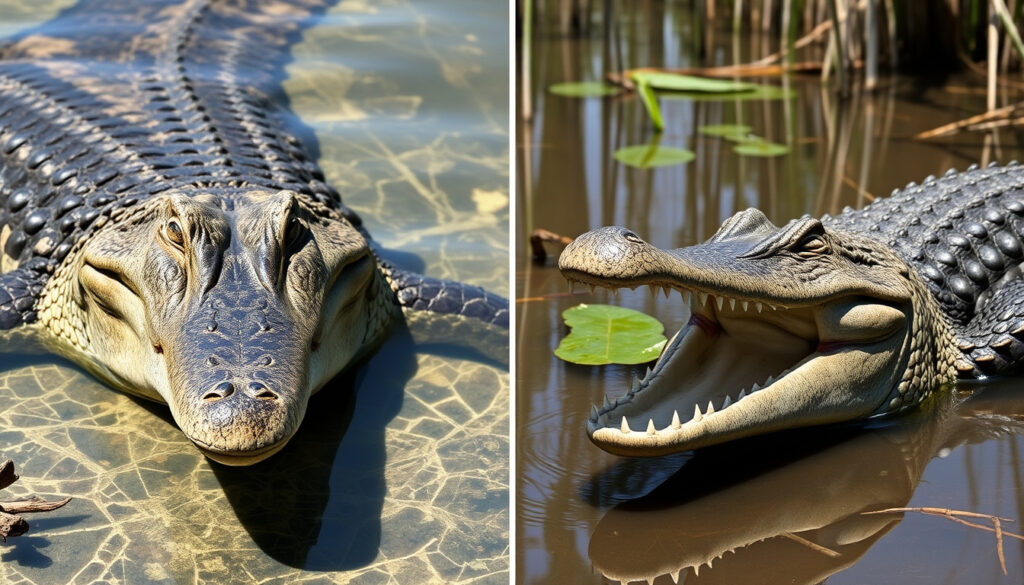
The most reliable field mark is the snout. Alligators carry broad, U-shaped jaws built for crushing hard-shelled prey like turtles. Crocodiles have narrower, V-shaped snouts optimized for catching fish and grabbing larger animals (PBS Nature). Look at the head from above—if the jawline curves smoothly like the letter U, you’re looking at an alligator. If it angles inward sharply, forming a V, that’s a crocodile.
“The alligator has a broad, rounded snout shaped like the letter U, while the crocodile’s snout is more narrow and V-shaped.” — Britannica
Snout shape
The snout distinction holds well for the two species Americans most often encounter: the American alligator and the American crocodile. Both inhabit southern Florida, so wildlife watchers in the Everglades need both markers (National Geographic). The pattern grows less reliable when you look across all crocodile species globally—some adult crocodiles develop broader, almost alligator-like jaws as they age. For the US context, though, the U-versus-V rule remains trustworthy.
“Many crocodiles, including some adult American crocodiles, develop broader, more alligator-like snouts as they age.” — PBS Nature
Teeth alignment
When a crocodile closes its mouth, you still see teeth protruding from both upper and lower jaws—the jaws are nearly equal width, allowing interlocking teeth. An alligator’s lower jaw fits inside the upper jaw, so only the top row of teeth shows when its mouth is shut. This overbite gives alligators a notably different smile—smooth along the bottom, with small dips where the lower teeth rest inside the upper jaw.
Color variations
Alligators typically appear darker—closer to black or dark grey—because they spend more time lounging in murky freshwater where algae darkens their hides. Crocodiles tend toward greener or more olive-brown tones, which blend better with reedy, brackish waterways. Neither color is foolproof, since individual animals vary and algae growth affects both species similarly.
For most wildlife encounters in North America, the snout and teeth check together gives you an ID in seconds: U-shaped head plus hidden bottom teeth means alligator. V-shaped head plus visible interlocking teeth means crocodile.
The implication is that even casual wildlife observers can distinguish these two apex predators with a glance at the jawline—no expertise required.
Which is stronger a crocodile or an alligator?
When it comes to raw size, crocodiles generally win. The Nile crocodile averages 11–16 feet and can reach lengths of 20 feet, making it the largest living reptile in Africa. Saltwater crocodiles—the biggest of all—can exceed 17 feet and weigh over a ton (Britannica). American alligators max out around 14 feet, with the record bull gator known as “Big Alpha” measuring just over 13 feet.
Size comparisons
The size gap matters most in confrontations. A 12-foot crocodile outweighs most adult American alligators by several hundred pounds. That said, individual animals vary dramatically, and older alligators in prime habitat can rival younger crocodiles in bulk.
Bite force
Both species possess extraordinary bite force—among the strongest in the animal kingdom. The saltwater crocodile measured in studies reaches roughly 3,700 psi, while alligators come in around 2,125 psi. For context, a human’s biting force tops out near 200 psi.
Fight outcomes
No verified scientific studies document staged fights between the two species. The few documented encounters in the wild tend to involve crocodiles killing smaller alligators, but these incidents are rare and depend heavily on relative size, location, and circumstance. Any claim about a guaranteed winner in a hypothetical fight should be treated as speculation.
If you’re evaluating risk in areas where both species overlap, a larger crocodile poses a greater physical threat. But aggression patterns matter too—both species will avoid humans when given the choice.
What’s more aggressive, an alligator or a crocodile?
Crocodiles are widely considered the more aggressive of the two. Saltwater and Nile crocodiles together account for the vast majority of fatal attacks on humans worldwide—estimates place crocodile attacks at several hundred per year globally, with a significant death toll. American alligators, by contrast, average fewer than one fatal attack per year (National Park Service).
Behavior in wild
Alligators in the southeastern United States typically tolerate human presence and will retreat if given space. Most “attacks” attributed to alligators in Florida involve habituated animals that have been fed by humans—breaking the natural wariness that keeps them skittish around people. Crocodiles, particularly in Africa and Australia, show no such hesitation and may view humans as legitimate prey.
Human encounters
Florida’s Everglades, where both species coexist, present a useful case study. The National Park Service reports that American alligators cause fewer than 20 serious injuries annually across the entire state. Nile crocodiles in sub-Saharan Africa kill an estimated 200–300 people per year, a disparity that reflects both biology and habitat.
Territoriality
Both species defend territories during breeding season, but crocodiles extend that aggression more readily toward any intruder—including humans. Alligators tend to be more selective, typically attacking only when guarding a nest, protecting food, or defending a basking spot.
If you encounter a claim of an “alligator-crocodile hybrid” being sold or displayed, be skeptical. The biology doesn’t support it, and such claims often accompany scams or attention-seeking hoaxes.
What this means is that human safety protocols must account for species-specific behavior—crocodile territory demands more caution than alligator space.
Can an alligator and crocodile breed together?
Biologically speaking, alligators and crocodiles belong to separate families (Alligatoridae versus Crocodylidae) and different genera (Alligator versus Crocodylus). This genetic distance creates a significant barrier—hybrids between distantly related crocodilian species rarely develop normally, and successful cross-genera breeding has never been scientifically verified.
Hybrid possibilities
Within the Crocodylus genus, some hybrid species have been documented in captivity—most notably between saltwater and Siamese crocodiles. These hybrids are typically bred for their skin quality. But no verified hybrid exists between a true alligator (Alligator mississippiensis) and any crocodile species.
Known cases
Rumors circulate online about pets like an “alley croc” or anecdotal reports from Florida. None of these claims have been substantiated with genetic testing, physical examination by herpetologists, or photographic evidence from credible sources. Most appear to stem from misidentified animals or deliberate misinformation.
Genetic barriers
The chromosomal difference between alligators (32 chromosomes) and crocodiles (42 chromosomes) alone makes viable offspring statistically unlikely. Even if an egg were fertilized, the chromosomal mismatch would almost certainly prevent proper embryonic development.
If you encounter a claim of an “alligator-crocodile hybrid” being sold or displayed, be skeptical. The biology doesn’t support it, and such claims often accompany scams or attention-seeking hoaxes.
Can a human outrun a crocodile or alligator?
On land, humans can outrun both species over distance—but not necessarily in the first few seconds. Alligators and crocodiles are explosive in short bursts, capable of sudden lunges reaching 10–12 mph for a few yards. Elite human runners exceed 15 mph for 100 meters, and the average jogger can manage 8–10 mph over longer distances.
Land speed
Neither species is built for sustained land chases. Their leg structure forces a high-centered, lumbering gait that burns energy quickly. The “death roll”—the spinning maneuver crocodiles use to subdue prey—requires water and cannot be executed on land effectively.
Burst capabilities
The danger comes from the first leap. Both species can cover roughly 10 feet in a single lunge, and they often wait motionless near water’s edge before launching. Anyone standing within 5–10 feet of the waterline is within striking range before a human can react and accelerate.
Escape strategies
Wildlife officials universally advise: give crocodilians plenty of space, and never stand at the waterline. If charged, run straight away—zigzagging wastes precious seconds. In water, do not swim near either species; they ambush from below and are far faster in their element.
Related reading: snout shape differences
Frequently asked questions
What color are alligators vs crocodiles?
Alligators typically appear darker grey to black; crocodiles tend toward greenish-brown. Color alone isn’t reliable since individual variation and algae growth affect both species.
Where do alligators and crocodiles live?
Alligators inhabit the southeastern United States and parts of China. Crocodiles occupy tropical regions worldwide—Africa, Asia, Australia, and the Americas—preferring brackish and saltwater environments.
Are crocodile bites stronger than alligator bites?
Yes—saltwater crocodiles have measured bite forces around 3,700 psi compared to American alligators at roughly 2,125 psi. Both far exceed any human’s biting power.
Do alligators and crocodiles share habitats?
Yes, in southern Florida. The American alligator and American crocodile both live in the Everglades, with alligators favoring freshwater marshes and crocodiles preferring more brackish coastal areas.
How do you tell an alligator from a crocodile by teeth?
When the mouth is closed, an alligator shows only top teeth. A crocodile shows teeth from both upper and lower jaws because its jaws are nearly equal width, allowing interlocking teeth to remain visible.
Which attacks humans more often?
Crocodiles—by a wide margin. Saltwater and Nile crocodiles cause several hundred attacks annually worldwide with high fatality rates. American alligators cause fewer than 20 serious injuries per year.
Can you swim near alligators or crocodiles?
No. Both species ambush from below the water surface. Swimming or wading in waters inhabited by either species is strongly discouraged by wildlife authorities and is the primary cause of attacks.
Confirmed
- Snout shape difference: U vs V is reliable for American species
- Tooth visibility patterns differ due to jaw width
- Crocodiles grow larger on average
- Crocodiles cause more human fatalities globally
Unclear / rumor
- Whether alligators could beat crocodiles in a fight remains speculative
- Reports of hybrid “alligators” remain unverified
- How climate change will shift overlap zones is not yet documented
More related posts
 Gammon in Air Fryer – Timings and Temperature Guide
 What Does AFK Mean? Texting, Gaming, Roblox Explained
 Xbox Game Pass Price 2025: Plans, Cost & Regional Breakdown
 Coffee Machine with Milk Frother: Best Picks for Ireland Homes
 Dylan Sprouse: Biography, Relationships, and Career in 2025
 Real Madrid vs Marseille – Champions League Preview
 Nuno Mendes: Biography, Career, and Personal Life Facts
 Bank of England Rate: Latest 3.75% Hold & 2026 Forecast