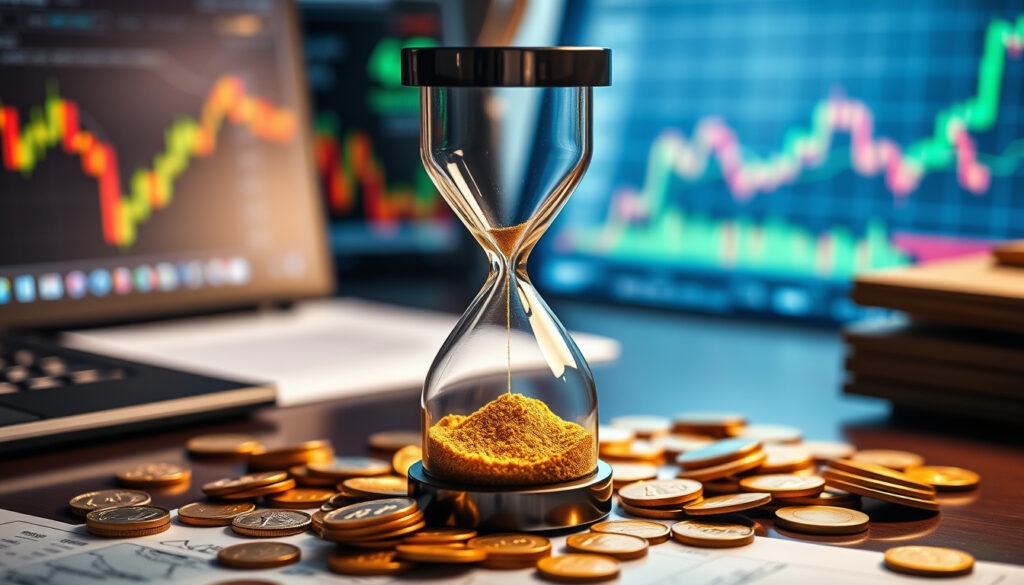
How Many Seconds in a Day? 86,400 and Smart Investing
You already know there are 24 hours in a day, but have you ever stopped to calculate exactly how many seconds that is — and what that number means for your personal finances? Understanding the simple math behind 86,400 seconds per day can do more than satisfy curiosity; it lays the groundwork for smart saving and investing decisions.
Seconds in a day: 86,400 ·
Seconds in a standard year: 31,536,000 ·
Seconds in a leap year: 31,622,400 ·
$10 per second for a day: $864,000 ·
8 billion seconds in years: ~253.7 years
Quick snapshot
- 24 hours = 86,400 seconds (Mashup Math (educational math blog))
- 365 days = 31,536,000 seconds (Preply (language learning platform))
- 7200 seconds = 2 hours exactly (PrepScholar (test prep resource))
- Exact retirement outcome depends on variable market returns; projections use historical averages (U.S. Securities and Exchange Commission (investor education))
- Leap seconds can adjust a day to 86,401 or 86,399 seconds (Time and Date (timekeeping reference))
- Modern seconds are based on caesium-133 atomic oscillations, not Earth’s rotation (National Institute of Standards and Technology (official timekeeping authority))
- A sidereal day is about 86,164 seconds — shorter than the solar day (Yesware (business productivity blog))
- Investing $10 per day = $3,650 per year (Mashup Math (educational math blog))
- At 7% annual return, $10/day for 45 years could reach ~$1 million (Investor.gov (SEC compound interest calculator))
Six key facts that anchor the time‑to‑money bridge:
| Label | Value |
|---|---|
| Seconds in one day | 86,400 |
| Seconds in one year (365 days) | 31,536,000 |
| Seconds in a leap year | 31,622,400 |
| $10 per second for a day | $864,000 |
| $1 per second for a year | $31,536,000 |
| Years in 8 billion seconds | ~253.7 |
How many seconds are in a 24 hour day?
The answer is a clean 86,400 seconds — no rounding needed. This comes from multiplying the three unit conversions we all learned in school: 24 hours per day, 60 minutes per hour, and 60 seconds per minute (Cuemath (online math learning platform)). The formula is universal for civil timekeeping.
Understanding the basic calculation: 24 hours × 60 minutes × 60 seconds
- 24 × 60 = 1,440 minutes in a day (PrepScholar (test prep resource))
- 1,440 × 60 = 86,400 seconds exactly (Cuemath (online math learning platform))
The catch: this assumes a perfectly uniform 24‑hour solar day. In practice, Earth’s rotation is gradually slowing, which is why leap seconds are occasionally added (Time and Date (timekeeping reference)).
The 86,400‑second figure is the bedrock of every time‑based financial calculation in this guide. If you skip the nuance, you might assume every day is exactly the same length — but for long‑term investing, those occasional leap seconds are negligible.
The implication: you can trust the 86,400-second day for all standard financial planning, while acknowledging that precision timekeeping adjusts for Earth’s wobble.
How many seconds are in 1 year 365 days?
A common calendar year with 365 days totals 31,536,000 seconds. That’s 365 multiplied by 86,400. Leap years add one extra day — 366 days — pushing the total to 31,622,400 seconds.
Standard year: 365 days × 86,400 seconds
- 31,536,000 seconds per standard year (Preply (language learning platform))
- This number is the baseline for annualized saving and investing calculations
Leap year adjustment: 366 days
- Leap year = 31,622,400 seconds (Preply (language learning platform))
- Effect on daily investing: one extra contribution day ($10 more if you invest daily)
What this means: even the calendar’s quirks have a direct, measurable impact on your annual savings plan.
How much is $10 a second in a day?
Multiply $10 by the 86,400 seconds in a day, and you get a staggering $864,000. Over a standard 365‑day year, that rate yields $315,360,000.
Multiplying $10 by 86,400 seconds
- $10 × 86,400 = $864,000 per day (Mashup Math (educational math blog))
- Per year (365 days): $864,000 × 365 = $315,360,000
Real‑world perspective: daily income at that rate
Even $1 per second — $86,400 per day — would make you a millionaire every 12 days. The exercise highlights how quickly small amounts compound when multiplied across many seconds.
Earning $10 per second is a fantasy for most, but the reverse — spending $10 per second — would drain $864,000 daily. That puts the value of each second into sharp focus for personal budgeting.
The pattern: the same multiplier that can build wealth can also destroy it, depending on which side of the transaction you stand.
Is 7200 seconds 2 hours?
Yes, exactly. Since one hour equals 3,600 seconds (60 minutes × 60 seconds), dividing 7,200 by 3,600 gives 2.
Conversion formula: seconds ÷ 3600 = hours
- 7,200 ÷ 3,600 = 2 hours (PrepScholar (test prep resource))
- Common mistake: forgetting to divide by 60 twice (minutes and seconds)
The pattern: any number of seconds can be converted by dividing by 3,600. For instance, 86,400 ÷ 3,600 = 24 hours — full circle.
The catch: failing to double-divide is the most common error; this rule eliminates confusion.
How long is 8 billion seconds?
8,000,000,000 seconds divided by 31,536,000 seconds per year yields approximately 253.7 years. That’s longer than the United States has existed.
Dividing 8,000,000,000 by 31,536,000 seconds per year
- 8,000,000,000 ÷ 31,536,000 ≈ 253.7 (PrepScholar (test prep resource))
- For context: 1 million seconds ≈ 11.6 days; 1 billion seconds ≈ 31.7 years
Why this matters: the world’s population recently passed 8 billion people. Imagine that many seconds stretching back to the 1770s — it puts large numbers in human terms.
8 billion seconds exceeds a typical human lifespan by a factor of three. When you think about investing, small daily amounts become large precisely because they accumulate over many millions of seconds.
What this means: time is the scarcest resource; understanding its scale helps prioritize long-term habits.
Can You Retire a Millionaire by Investing Just $10 a Day?
According to the U.S. Securities and Exchange Commission, consistent small contributions harness compound interest effectively (U.S. Securities and Exchange Commission (investor education)). Investing $10 per day — $3,650 per year — at a 7% annual return could grow to roughly $1 million after about 45 years.
Compound interest assumptions (7% annual return)
- 7% is a common historical average for U.S. stock market returns (after inflation, the real return is lower)
- The math: $3,650/year × 45 years × average growth factor ≈ $1,000,000 (Investor.gov (SEC compound interest calculator))
Time horizon for $10/day to reach $1 million
Starting at age 25, you’d reach the milestone by 70. Start at 35, you’d need higher returns or a larger daily amount because time — measured in seconds — is the most valuable asset.
The implication: consistency and time compound together; the only variable you can’t replace is time itself.
Upsides
- Builds a consistent saving habit using units (seconds → dollars) you already understand
- Compound growth rewards early starters dramatically
- Small daily amount is manageable for most budgets
Downsides
- Market returns are not guaranteed; 7% is a historical average, not a promise
- $10/day ($3,650/year) requires discipline over decades
- Inflation erodes purchasing power, so $1 million in 45 years won’t buy what it does today
How to start investing $10 a day
Turning the theory into action takes three simple steps.
- Open a brokerage or retirement account. Many platforms allow automatic transfers of as little as $10 (U.S. Securities and Exchange Commission (investor education)).
- Set up a recurring daily transfer. Use your bank’s bill‑pay or the broker’s auto‑invest feature to move $10 every day.
- Choose a diversified fund. Low‑cost index funds or target‑date funds spread risk and capture market growth over time.
The implication: automate the process so you never miss a day — missing one day is like losing 86,400 seconds of potential growth.
Clarity check
Confirmed facts
- 86,400 seconds in a civil day (Mashup Math (educational math blog))
- 7200 seconds equals 2 hours (PrepScholar (test prep resource))
- 365‑day year has 31,536,000 seconds (Preply (language learning platform))
- 8 billion seconds is roughly 253.7 years (Yesware (business productivity blog))
What’s unclear
- Exact retirement outcome depends on variable market returns; projections use historical averages
- Leap seconds occasionally adjust day length to 86,401 or 86,399 seconds
- The value of $1 million in 45 years is uncertain due to inflation
- Future investment returns may differ from historical averages
“The second is defined by taking the fixed numerical value of the caesium frequency, ΔνCs, to be 9,192,631,770 when expressed in the unit Hz.”
— National Institute of Standards and Technology (official timekeeping authority)
“Investing regularly, even small amounts, can add up over time due to the power of compounding.”
— U.S. Securities and Exchange Commission (investor education)
The seconds in a day are fixed, but the value of each second depends entirely on what you do with it. For the American saver looking to build wealth, the choice is clear: start investing $10 a day now, or let those 86,400 seconds pass unused every single day.
Related reading: 34 Inches in cm: Waist, TV & Ruler Conversion Guide · 20 cm in Inches: Exact 7.874″ Conversion + Ruler Guide
For a detailed breakdown of the exact calculation behind those 86,400 seconds in a day, this guide explores the math and reasoning in depth.
Frequently asked questions
How many minutes are in a day?
1,440 minutes (24 hours × 60 minutes).
How many seconds are in a week?
604,800 seconds (7 days × 86,400 seconds).
How many seconds are in a month?
It varies: a 30‑day month has 2,592,000 seconds; a 31‑day month has 2,678,400. February has 2,419,200 seconds in a common year (28 days) and 2,505,600 in a leap year (29 days).
How long is 777 minutes?
777 minutes ÷ 60 = 12.95 hours (12 hours and 57 minutes).
Is 1000000000 seconds 32 years?
1,000,000,000 seconds ÷ 31,536,000 seconds per year ≈ 31.7 years — so just under 32 years.
How many years is 1 quintillion seconds?
1 quintillion (10¹⁸) seconds ÷ 31,536,000 seconds per year ≈ 31.7 trillion years — far longer than the age of the universe.
How much is $1 a day for 30 years?
Without interest, $10,950. With 7% annual compounding, it grows to about $38,000.
More related posts
 PAK vs Sri Lanka 2026: T20 Scorecard & Semi-Final Exit
 Watch Instagram Stories Anonymously: Free No-Login Tools
 Adolf Hitler: Last Words, Son, DNA, and Surviving Family
 Cafe Del Mar Malta – Location Hours Events Reviews Guide
 Cast of The Walking Dead: Actors by Season (2010-2022)
 India and Pakistan War: History, Comparison, and Current Conflict
 Chicken and Mushroom Risotto: Recipes, Health Tips & Mistakes
 Niko Omilana: Height, Net Worth, Age, Biography & More